Facing an indecent exposure charge can lead to significant penalties, including a criminal record, a prison sentence and inclusion on the Sex Offenders Register. Despite this severity, there are several common misunderstandings about what indecent exposure involves and what behaviours could result in someone being accused of this serious offence. For example, many people are unsure whether public nudity can result in you being charged with indecent exposure, or whether disorderly behaviour or other such offences are required to meet the definition.
Early legal advice can help you to protect your rights and learn what to expect from a criminal prosecution if you have been accused of indecent exposure, public indecency or other sexual offences. The team at Tyler Hoffman has a strong track record of success in most indecent exposure cases, and can help you to avoid the most serious consequences if you have been falsely accused or if there are problems in the prosecution's case.
In this guide, our sexual offences solicitors provide a factual overview of what is classed as indecent exposure in England and Wales, the potential penalties and maximum prison term you could face, and the defences that can be raised on your behalf.
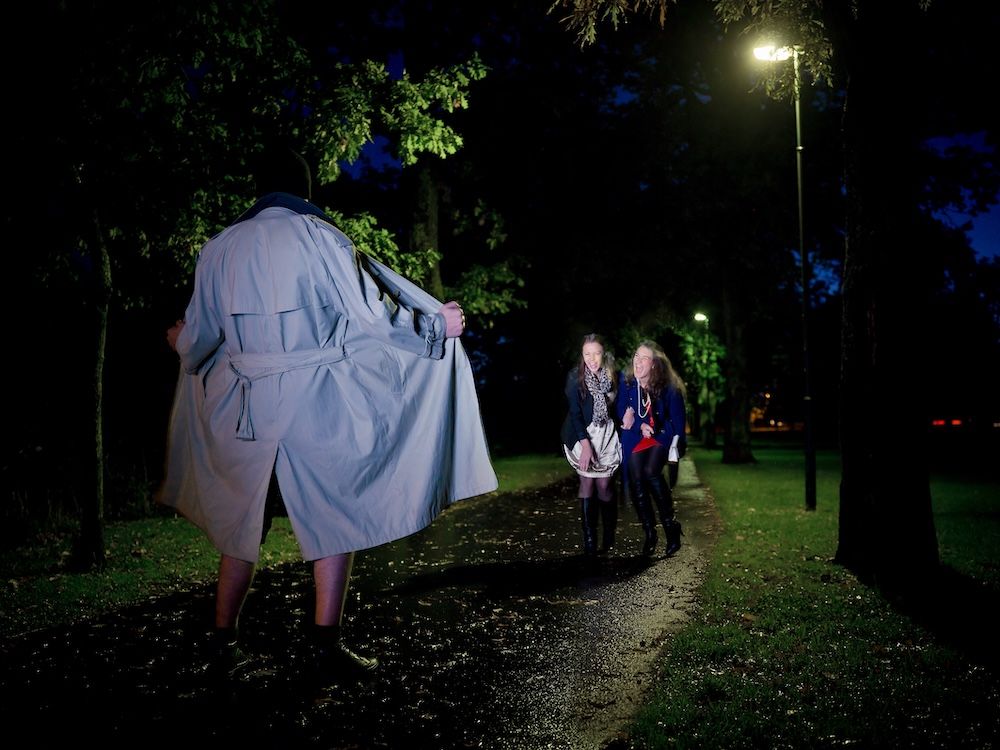
What Is the Legal Definition of Indecent Exposure?
Indecent exposure is not only a criminal offence, but a sexual offence, which means that it can have serious consequences if you are convicted. However, there are several points that the prosecution must prove to result in a conviction. The primary legislation that governs indecent exposure and related behaviours is the Sexual Offences Act 2003. The legal definition is precise and hinges on the concept of intent.
Under Section 66, the criminal offence of exposure is committed if a person intentionally exposes their genitals and they intend that someone will see them and experience alarm or distress. The Sexual Offences Act 2003 specifically refers to the "genitals" and while the law does not provide an explicit definition, the term is presumed to refer to the external genitalia of both males and females. The intentional exposure of other body parts would not constitute indecent exposure under this specific law, although it could potentially fall under other public order offences.
Indecent exposure is a "specific intent" offence, which means that it is not enough for the prosecution to prove that exposure occurred. A conviction of indecent exposure requires the prosecution to show that the person intentionally exposed themselves for a particular effect and prove the defendant's state of mind at the time beyond a reasonable doubt.
A common misconception is that indecent exposure must occur in a public place. In fact, the offence can be committed in any location, including a private setting, provided the person who intentionally exposed their genitals intended for someone to see them and cause alarm or distress.
How Does the Crown Prosecution Service Prove Indecent Exposure Cases?
Many of the available defences to an indecent exposure charge involve challenging the prosecution's evidence, or demonstrating a lack of intent on the part of the defendant. To secure a conviction, the Crown Prosecution Service (CPS) must establish three key points:
- The individual deliberately and intentionally exposed their genitals. An accidental exposure does not meet this legal threshold.
- The person intended for their genitals to be seen by another person.
- The defendant wanted the person seeing them to feel alarm or distress, and the act was aimed at eliciting this specific reaction.
While this requirement to prove intent offers room for a strong defence, it also means that the material impact of any indecent exposure is less relevant. The offence of indecent exposure is committed if the intent was present, regardless of the outcome. This means, for example, that the law does not require proof that anyone actually saw the defendant's genitals or was caused alarm by the exposure, only that the alleged offender intended that this would happen.
The CPS will look for witness statements, CCTV or phone camera footage, and other evidence to prove that the alleged events occurred and the intent behind them. In cases of "cyber flashing", an offence introduced by the Online Safety Act 2023, digital evidence may also be brought into the case, including any messages or social media communications between the parties involved. These offences are treated with similar severity to in-person indecent exposure where the intent to cause alarm, distress or to obtain sexual gratification can be proven.
How Does Indecent Exposure Differ from Other Sexual Offences?
While proving intent is key to indecent exposure, there are related offences with which you may be charged for other, related behaviours where the intent to cause alarm or distress was not a factor. These include public nudity and public urination, both of which may involve nudity and can result in being charged with an offence, but are not treated with the same level of severity as indecent exposure because of the lack of intent.
Public nudity
In England and Wales, public nudity is not automatically illegal. Activities such as streaking at a sporting event or topless sunbathing are not typically classed as indecent exposure because the requisite intent to cause alarm or distress is absent.
However, public nudity can become a criminal offence in specific circumstances. This applies if it is deemed to cause harassment, alarm or distress, even if no intent can be shown. This could lead to a charge under the Public Order Act 1986. In more extreme cases, it could be prosecuted under the common law offence of "outraging public decency." This is a broader offence that involves an act of an obscene or sexual nature in a public place where it could be witnessed by at least two people.
Public urination
Public urination involves the exposure of genitals, but it is typically handled as a public order offence or a breach of local by-laws. This is because the primary intent behind public urination is generally a physical necessity rather than an intent to be seen to cause alarm or distress. The typical penalty is a fine or a penalty notice for disorder.
With this said, the surrounding circumstances are critical. If an individual carries out the act in a manner that is clearly designed to be seen and to intimidate or upset someone, they could be charged with indecent exposure.
What Are the Penalties for Indecent Exposure?
The sentencing guidelines for indecent exposure allow for severe penalties that may have lasting consequences for an individual's personal and professional life. Less serious indecent exposure cases will be handled as a summary offence in the Magistrates' Court. For a summary conviction, the maximum penalty is six months in prison, an unlimited fine or both.
For more serious or repeat offences, the case may be sent to the Crown Court. Upon conviction on indictment, the maximum jail sentence is up to two years' imprisonment. Other potential outcomes include a community order, which involves supervision and unpaid work (community service), or a suspended prison sentence.
Another significant consequence is a requirement to be placed on the Sex Offenders Register. This is a near-automatic outcome following a conviction. The length of time an individual must remain on the register depends on the sentence they receive:
- A custodial sentence of over six months: 10 years on the register.
- A custodial Sentence of six months or less: seven years on the register.
- A community order: five years on the register.
- Conditional discharge: the duration of the discharge.
Being on the Sex Offenders Register places strict notification requirements on an individual, including reporting their address to the police and notifying them of any foreign travel. This can have a profound impact on employment, travel and personal relationships. As such, it is vital to work with a solicitor when you are accused of indecent exposure or a related offence, mount a defence that could have the charges dropped or minimise any penalty imposed.
How Can a Solicitor Defend Against Indecent Exposure Accusations?
An experienced solicitor from the team at Tyler Hoffman can offer expert legal advice and representation during any criminal investigation or prosecution related to indecent exposure. We can play a key role in building a strong defence that will help you to avoid a conviction or, where that is not possible, present mitigating factors that will reduce your sentence. Possible defences include:
Lack of Intent to Cause Alarm or Distress
If it can be demonstrated that there was no intent to cause alarm or distress, the charge of indecent exposure cannot be substantiated.
Accidental Exposure
If the exposure was genuinely accidental, the necessary intent for committing indecent exposure is absent. Examples where a defence of accidental exposure could be successful include unintentional exposure due to an issue with clothing or during a medical emergency.
Mistaken Identity
In cases that rely on witness statements or poor-quality CCTV footage, a defence of mistaken identity may be viable. An investigation into the evidence, including witness testimony and CCTV footage, may reveal inconsistencies or weaknesses that undermine the prosecution's claim that you were the person who committed the act.
Reasonable Expectation of Privacy
If the exposure occurred in a place where you had a reasonable expectation of privacy, or in a context where nudity is accepted (such as a designated naturist beach), this can form a strong defence. It challenges the argument that you had the specific intent to be seen and cause alarm or distress to an unwilling observer.
Mitigating Factors
Mitigating factors are circumstances that may lessen the severity of the offence and can lead to a more lenient sentence. An experienced solicitor will ensure that all relevant information is presented to the court to achieve the fairest possible outcome. This means that, even if you cannot avoid a conviction, your sentence will not be overly harsh.
Mitigating factors may include:
- A lack of previous convictions or clean criminal record, which can show that the act was out of character.
- The defendant demonstrating clear and genuine remorse for their actions.
- The presence of a diagnosed mental health condition or mental illness that may have contributed to the behaviour. Mental health issues can be a complex but important factor in indecent exposure cases.
- Full cooperation with the police investigation.
- An early guilty plea.
Tyler Hoffman will meticulously review the details of your case to identify and present any mitigating factors to the court during sentencing. It is also important to understand that a history of similar sexual offences or being a repeat offender will significantly increase the severity of the sentence, as can incidents that targeted a child or vulnerable person, or happened in a place where children are likely to be present, such as near a school or park. These act as aggravating factors that the prosecution will raise against you.
What to Do if You Are Accused of Indecent Exposure
If you are facing allegations, have been arrested, or have been asked to attend an interview at a police station, you should seek legal assistance urgently. At Tyler Hoffman, our specialist solicitors understand the full extent of UK indecent exposure laws, and will help you to build a strong defence. We can provide confidential advice for your journey through the legal system, represent you during police interviews and meticulously build a defence strategy by scrutinising evidence and challenging assumptions.
For those charged with indecent exposure, our solicitors will either prepare a robust defence for trial or, if you plead guilty, present all mitigating factors to ensure the sentence is as fair as possible. Call Tyler Hoffman today on 03300 536 786 to learn how our legal representation can make all the difference to your case, or use our online enquiry form to request a call back.